



Revision Blepharoplasty World Renowned Harley Street London
Dr Julian De Silva #1 Specialist Blepharoplasty Surgeon
Over 1000 5-Star Patient Experiences
Revision Blepharoplasty Specialist
Fast Recovery Technology
Natural Artistry
FACELIFT SURGERY IN HARLEY STREET
Revision Blepharoplasty
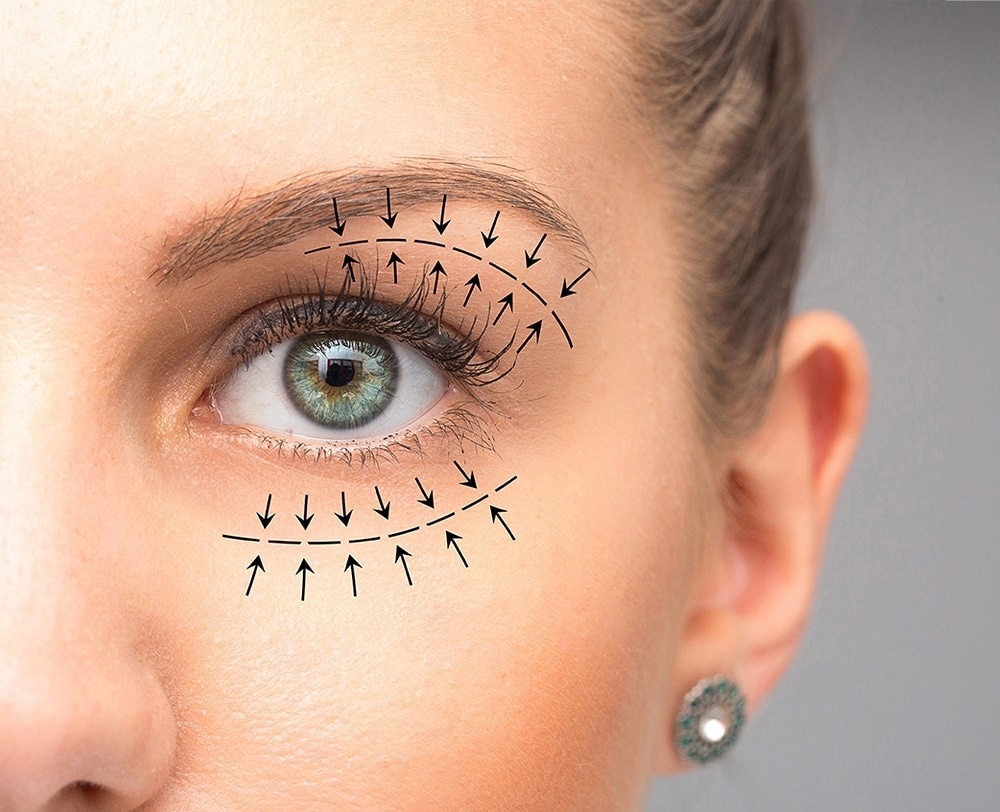
The eyelids are a complex part of the face with a unique anatomy and function—millimetres are the difference between success and failure during blepharoplasty procedures.
Dr Julian De Silva commonly has patients come to him for revision blepharoplasty with issues including upper eyelid asymmetry, visible scars, remaining bulging of fat in the inner aspect of the eyelid, excess loose skin the outer aspect of the eyelid, puffiness & asymmetry of the lower eyelids, inadequate evaluation of brow position and many more. The upper eyelid has an important function protecting the eye and in the prevention of dry eyes and the removal of too much soft tissue and skin is problematic if not performed correctly.
Complications of excessive soft tissue removal are best avoided by seeing a specialist eyelid surgeon with Oculo-Facial Plastic Surgery or Facial Plastic Surgery expertise. Dr Julian De Silva has worked in some of the best specialise eye hospital in the world including Moorfields Eye Hospital in London, Jules Stein eye hospital at UCLA in Los Angeles and University Hospital for Albert Einstein in New York. Approximately thirty percent of Dr De Silva’s blepharoplasty surgeries are revisions surgeries.
Corrective surgery is complex and often requires specialist techniques to ensure preserving natural anatomy. Often additional measures are required to help with recovery.
How do you approach revision upper eyelid surgery?
Previous eyelid surgery results in scarring and changes in the underlying anatomy. Although scars can be modified and enhanced previous surgery cannot be reversed.
Dr De Silva uses a spectrum of specialised techniques to restore the position and function of the eyelids, including a variety of graft tissues (including tissue taken from the roof of the mouth, termed hard palate and spacer materials), eyelid tendon suturing, HD visualisation and bony orbital support to ensure a long-term result.
Each revision eyelid surgery is unique and requires customised treatment with respect to the position, shape, scarring and function of the eyelid.
Dr De Silva uses specialised anti-inflammatory medications to reduced scarring—a technique he has pioneered in the UK.
Dr De Silva is able to achieve excellent results in revision blepharoplasty, and will operate on cases where he feels he can achieve a success that is within the patient’s expectations. If he cannot achieve this he may advise against further surgery.
Why Choose Dr De Silva in Harley Street, London ?
Dr Julian De Silva is a widely credited and celebrated facial plastic surgeon who specialises ONLY in the FACE. Eyelid surgery, AKA blepharoplasty is the No.1 procedure that he helps patients with every day. Your face has intricate anatomy; your eyes, nose, face and neck areas, and relatively unique. Dr Julian De Silva is known for Natural Results & Fast Recovery technology.
“We are proud to have over 1000 5* reviews. My focus has always been to be the very best at what I do, to continually innovate to provide World Class leadership with my team, my patients and my associates. My mission is to help every patient be the very best version of themself with World-Class services, life-long follow up with complimentary facial aesthetic procedures.”
Author of the Blepharoplasty Book, The Patient Guide to Blepharoplasty & Eyelid Surgery, to help our patients make the best decisions we gift this book to all our patients. In this book is a discussion on revision blepharoplasty with case studies of Dr Julian De Silva’s revision blepharoplasty patients.
As an Artist, Dr De Silva’s paintings can be see on the walls in the World Class Facility at 23 Harley Street, custom built for Facial Procedures.
As a father and a Family Man he understands how important our appearance, health and well being is for happiness. Dr De Silva is in demand, please be patient if we are unable to offer you an appointment immediately, Dr De Silva is a detailed surgeon, he takes extra time with every patient to understand your needs and expectations, facial treatment is a blend of both precision and artistry, and takes time.

Only the Face
By focusing entirely on only facelift & facial cosmetic surgery procedures, Dr De Silva is able to provide the expertise that can only come with specialisation. Dr De Silva has authored multiple books on patient education and care including Dr Julian De Silva's Blepharoplasty patient guide , Dr De Silva's Facelift & Neck Lift book and Rhinoplasty book.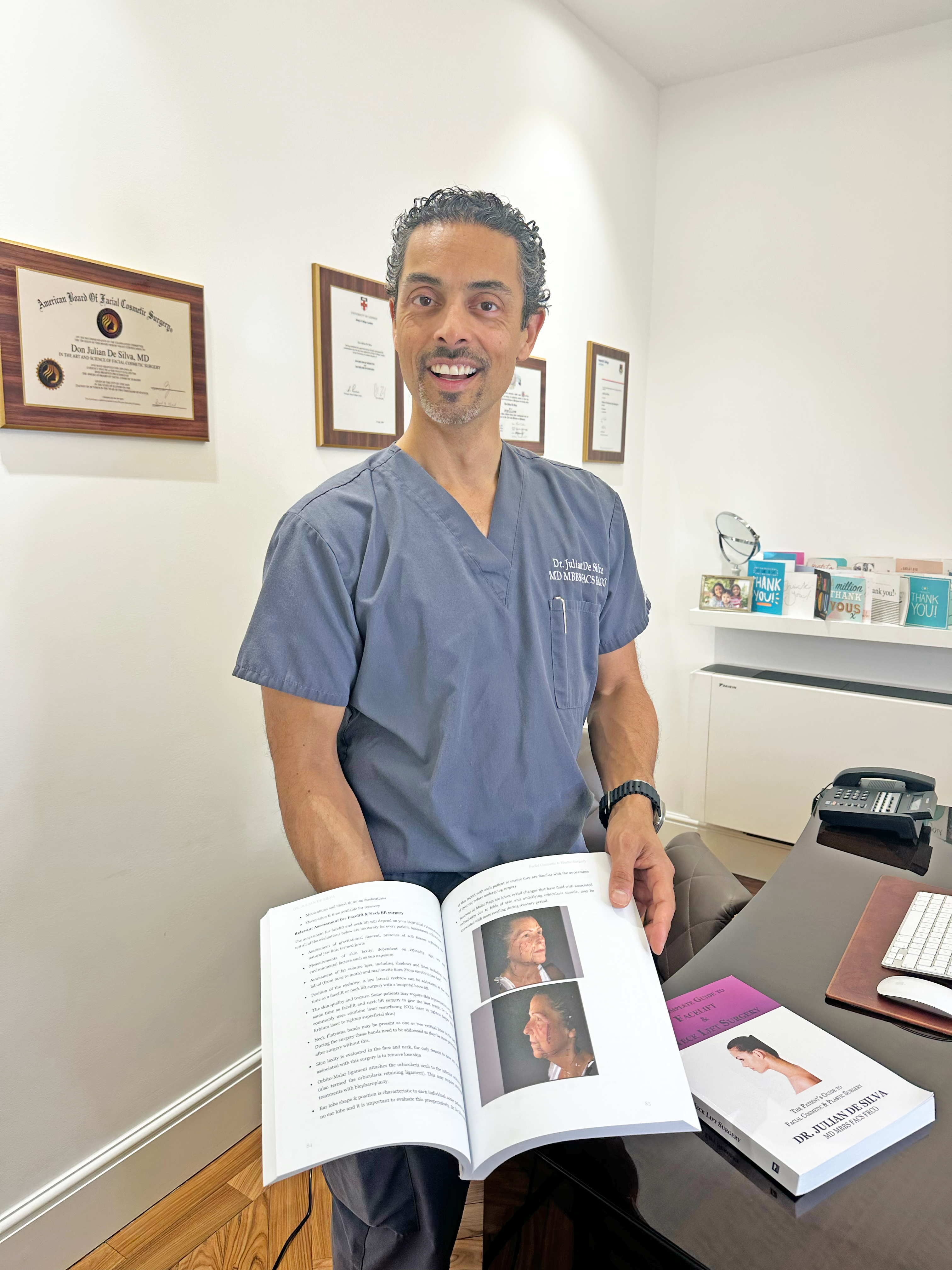
Fast Recovery
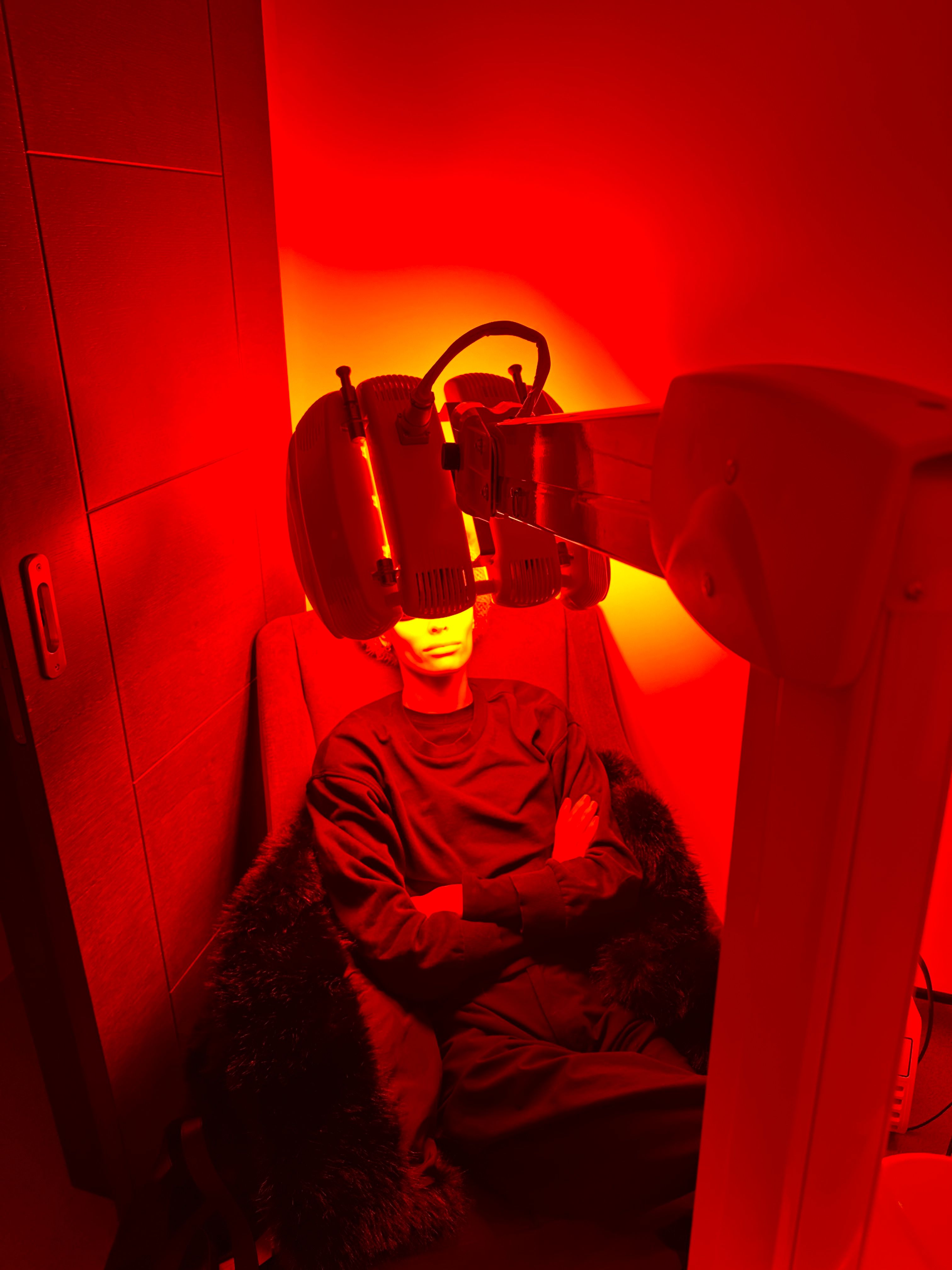
Dr De Silva has pioneered the advances in technology to speed up recovery with a combination regenerative medicine techniques, Oxygen and LED Therapy (e.g. Case Study- Fast recovery after facelift & neck lift surgery).
World Class Expertise
Dr De Silva also teaches other surgeons internationally and has contributed to the development of advanced surgical techniques, laser technology and stitch-less tissue adhesives. Dr De Silva and his team have won numerous awards over the years.
Natural Looking Results
Dr De Silva is a believer in the importance of artistry behind cosmetic results and focuses his skills at delivering natural looking results. Dr De Silva's portrait paintings decorate the walls of 23 Harley Street Clinic.

Revision Blepharoplasty Surgery Overview
Will I be happy after revision eyelid surgery?
Dr De Silva only provides patients with honest information about the likely expectations from revision surgery. In a minority of patients, he advises against surgery altogether.
Although most patients’ symptoms are improved significantly, it is important to have a discussion regarding realistic expectations, as previous scarring can only be improved upon, not reversed. A small proportion of patients may require two procedures.
Can the blepharoplasty complications be corrected?
As a first step Dr Julian De Silva completes a thorough examination of your eyes to look at the unique characteristics of your eyes, anatomy and asymmetry (…eyelid tendon laxity, skin shortage, functional dryness). Although this is best evaluated in person, for patients living long distances from London a virtual consultation with good quality photographs can be used.
As a specialist in revision blepharoplasty, Dr Julian De Silva has helped many patients with complications from previous surgery, these include: visible scarring, asymmetry, retraction, change in natural eyelid appearance and many more. Key is to assess in detail the changes that have occurred and then use advanced techniques including revision blepharoplasty, fat transfer, skin resurfacing, regenerative medicine and vertical deep plane facelift techniques (if pulling of the lower eyelid to elevate this area naturally without older school unappealing skin grafts). Expectations for improvement are important, often eyelid shape can be improved however perfection is so challenging to obtain.
Revision Blepharoplasty
Revision eyelid surgery is carried out to correct previous unsatisfactory blepharoplasty surgery.
The anatomy and soft tissues of the lower eyelid are highly intricate, and once surgery has been completed there is a degree of scarring and change in anatomy that is unique to each individual patient.
The level of scarring is dependent upon multiple factors, including the previous surgery, the surgeon, the ethnicity of the patient, their individual genetic makeup and their body’s ability to heal.
The treatment of patients who have undergone previous lower blepharoplasty is challenging, and is dependent upon the degree of change required and the patient’s expectations from surgery. Although for most patients a substantial improvement can be made, the key to success is achieving the patient’s expectations.
In the eyelids, removal of too much soft tissue results in the increased appearance of the white sclera and the eyelids not closing, or hanging below the coloured iris. This can be improved though for some patients advanced techniques including fat grafting, elevation of the cheek (deep plane facelift surgery) and graft material may be required.
Revision lower eyelid surgery (lower eyelid retraction)
- There are a variety of causes for lower eyelid retraction including trauma, eyelid tumours and the commonest—internal scarring after a lower eyelid blepharoplasty.
Lower eyelid retraction is often the result of a combination of factors, including the removal of too much skin tissue during lower blepharoplasty surgery, scarring and the lower lid being pulled downwards - The lower eyelid has intricate anatomy with three fine anatomical planes in the eyelid. Damage to any of these structures may lead to scarring and lower lid retraction. The results can be devastating to the patient as scarring changes the shape of the eye resulting in a compromised cosmetic result, tearing and discomfort.
- Dr De Silva’s preferred technique for lower eyelid surgery involves a hidden incision on the inside lining of the eyelid. This technique preserves the natural anatomy of the eyelid and hides scarring.
- The more traditional method that is used by surgeons practicing older surgical techniques is termed trans-cutaneous blepharoplasty. In patients with a specific anatomy, termed negative vector, it is of absolute importance not to use these techniques to ensure a risk-free result.
- Dr De Silva’s preferred technique for lower eyelid surgery involves a hidden incision on the inside lining of the eyelid. This technique preserves the natural anatomy of the eyelid and hides scarring.

Case Study
A 59-year-old Asian patient who works as a nurse in a London Hospital had two previous eyelid procedures in UK hospitals with plastic surgeons.
She felt that she had continued to look tired as there was hooding of the upper eyelids, with swelling of fat at the inner aspect of the eyelids. In the lower eyelids she had fat bags despite the previous surgery.
She came to see Dr Julian De Silva in his London practice, for revision eyelid blepharoplasty.
On examination, there was asymmetry with double skin creases on the upper eyelids, asymmetrical scars in the lower eyelids and fat prolapsing in the lower eyelids, as well as noticeable scarring.
Dr De Silva evaluated her changes and discussed with her what aspects of her eyelids could be improved. With clear expectations from the surgery, she had revision upper and lower eyelid surgery under sedation anaesthesia.
After surgery there was an improved appearance to her upper and lower eyelids. Dr De Silva hid the previous scars in natural creases in the upper eyelid and used hidden incision techniques in the lower eyelid (termed transconjunctival blepharoplasty).
The patient was very happy with the results and has subsequently returned to her home country.
Blepharoplasty Before & Afters
Dr De Silva has transformed thousands of faces through his unique surgical techniques. Below is a small sample of some of his transformations.

This 27-year-old woman wanted to address under-eye bags while keeping a completely natural look. Dr De Silva performed hidden-incision lower eyelid surgery with fat removal, canthopexy, CO₂ laser resurfacing, and upper blepharoplasty to restore eyelid definition. The result is a refreshed, youthful appearance that highlights her natural eye shape—without anyone knowing she had surgery.
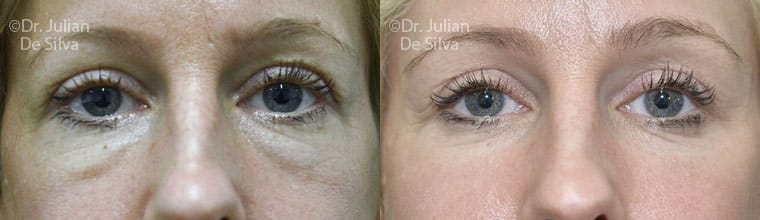
This young woman sought treatment for a tired look caused by lower eyelid swelling and bags. Dr De Silva performed a hidden-incision lower blepharoplasty with fat transfer and skin resurfacing, achieving a refreshed, youthful, and natural result shown at 8 weeks post-op. She was very happy with her outcome.
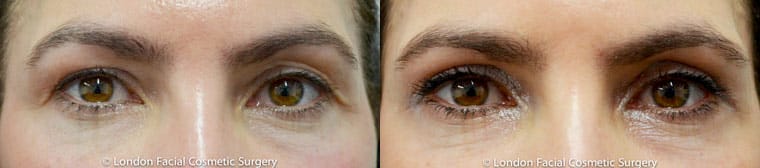
This woman in her 40s sought a natural correction after unsatisfactory upper eyelid surgery. Dr. De Silva performed a conservative revision upper blepharoplasty, achieving a refreshed, smooth appearance at 8 weeks post-op. The result looks natural, and friends noticed how refreshed she appeared.
This 27-year-old woman wanted to address under-eye bags while keeping a completely natural look. Dr De Silva performed hidden-incision lower eyelid surgery with fat removal, canthopexy, CO₂ laser resurfacing, and upper blepharoplasty to restore eyelid definition. The result is a refreshed, youthful appearance that highlights her natural eye shape—without anyone knowing she had surgery.
This young woman sought treatment for a tired look caused by lower eyelid swelling and bags. Dr De Silva performed a hidden-incision lower blepharoplasty with fat transfer and skin resurfacing, achieving a refreshed, youthful, and natural result shown at 8 weeks post-op. She was very happy with her outcome.
This woman in her 40s sought a natural correction after unsatisfactory upper eyelid surgery. Dr. De Silva performed a conservative revision upper blepharoplasty, achieving a refreshed, smooth appearance at 8 weeks post-op. The result looks natural, and friends noticed how refreshed she appeared.
What our satisfied clients are saying
“Having Lower Blepharoplasty with Dr. De Silva gives you the benefit of years of experience, qualifications not only in the U.K. but also the U.S. and yet you don’t lose the gentle bedside manner from this doctor. From our first meeting, Dr. De Silva won me over because he gave me the time to obtain answers and explanations to all my questions in kind details, as many times as I needed.”
Sandra
Eyelid/Blepharoplasty Frequently Asked Questions
What is revision blepharoplasty, and what can it correct?
What is revision blepharoplasty, and what can it correct?
Revision blepharoplasty corrects or improves the results of previous eyelid surgery that has not achieved the desired outcome, or where complications have occurred. The most common issues Dr De Silva is asked to address are over-removal of skin or fat leaving a hollowed, skeletal appearance; ectropion, where the lower lid has pulled away from the eye; asymmetry between the two sides; visible or poorly placed scarring; and a rounded or distorted eye shape caused by incorrect technique. Revision eyelid surgery is technically more demanding than primary surgery because the tissue has already been operated on, the anatomy is altered, and the margin for error is narrower. It requires a surgeon with specific experience in both the original procedure and its correction.
Why do some blepharoplasty results look unnatural or cause complications?
Why do some blepharoplasty results look unnatural or cause complications?
The most common cause of unsatisfactory blepharoplasty results is over-remova; taking out more skin or fat than the anatomy can support. In the upper eyelid, this creates a hollowed, surprised or prematurely aged appearance. In the lower eyelid, excessive fat removal leaves a sunken, gaunt contour, while excessive skin removal pulls the lid downward, causing ectropion. The second common cause is incorrect technique selection; using a one-size approach rather than one tailored to each patient's specific anatomy, age, skin quality and aesthetic goals. Dr De Silva's philosophy, applied to both primary and revision surgery, is that what is not removed cannot be undone. Precision and restraint at the first operation is always preferable to correction later , but when correction is needed, the right approach is restorative rather than simply repeating the original technique.
How long should I wait before having revision blepharoplasty?
How long should I wait before having revision blepharoplasty?
Timing is one of the most important considerations in revision blepharoplasty. As a general principle, Dr De Silva recommends waiting a minimum of twelve months after the original procedure before undergoing revision surgery. This allows the tissue to fully heal, residual swelling to resolve, and the final result of the first operation to become clear- what appears to be a problem at three months may look significantly different at twelve. Operating before the tissue has fully settled increases the technical difficulty of the revision and can compromise the outcome. There are exceptions: if ectropion is causing exposure of the eye surface, or if there is a functional concern affecting vision or eye health, earlier intervention may be appropriate and will be assessed individually.
What techniques does Dr De Silva use to correct previous eyelid surgery?
What techniques does Dr De Silva use to correct previous eyelid surgery?
The technique used for revision blepharoplasty depends entirely on what the original surgery has left behind and what needs to be restored. Where fat has been over-removed, micro-cannula fat transfer is used to restore volume to the upper or lower lid without the lumpiness or unpredictability of older fat grafting methods. Where the lower lid has been pulled down, canthopexy or canthoplasty, procedures that support and reposition the lid margin, are used to restore the correct anatomical position. Where scarring is visible or causing distortion, careful scar revision and repositioning of incisions can improve appearance significantly. Dr De Silva's fellowship training in oculo-facial plastic surgery at Moorfields Eye Hospital, UCLA Jules Stein Eye Institute and Albert Einstein College of Medicine means he has operated on complex revision eyelid cases at the highest specialist level. His use of fibrin tissue adhesive, supported by his own randomised controlled trial in eyelid surgery, further supports precision healing in the revision setting.
Can volume lost from over-removal of fat be restored?
Can volume lost from over-removal of fat be restored?
Yes , restoring lost volume is one of the most common goals of revision blepharoplasty, and micro-cannula fat transfer is the most reliable method for achieving it. Fat is taken from elsewhere on the body, processed and reintroduced into the upper or lower eyelid using very fine cannulas that allow precise placement without damaging surrounding tissue. The result is a gradual restoration of volume that looks natural rather than filled. This approach is particularly effective for the hollowed upper eyelid and the sunken lower lid contour that result from over-aggressive primary surgery. Results continue to improve over several months as transferred fat integrates and residual swelling resolves. Not all transferred fat will survive long-term, and a second session is occasionally needed but this is discussed honestly at consultation.
What is the recovery from revision blepharoplasty, and is it different from a first procedure?
What is the recovery from revision blepharoplasty, and is it different from a first procedure?
Recovery from revision blepharoplasty is broadly similar to primary surgery but can take longer, as previously operated tissue heals more slowly and less predictably. Bruising and swelling in the first one to two weeks are expected. A strict ice regime for the first three days (ten minutes per hour) reduces swelling significantly, and the head should be kept elevated at 45 degrees when sleeping. Sun exposure must be avoided for a minimum of six weeks, with SPF sunscreen, UV-protective sunglasses and a hat worn whenever outdoors, as healing tissue around the eye is particularly vulnerable to hyperpigmentation. Some numbness or altered sensation can occur and may take up to six months to fully resolve. Normal exercise typically resumes at four weeks. Because revision surgery involves more complex tissue handling, swelling can be more pronounced and the timeline to final results slightly longer- most patients see their settled outcome at six to twelve months.
How do I know if Dr De Silva can help me, and what should I bring to a revision consultation?
How do I know if Dr De Silva can help me, and what should I bring to a revision consultation?
Over 20% of Dr De Silva's patients come to him to correct or improve results from surgery performed elsewhere - revision blepharoplasty is a significant and established part of his practice, not an occasional exception. At a revision consultation, he will assess the current state of the eyelids in detail, review photographs of the original result where available, and give an honest assessment of what can realistically be improved and what cannot. Not every revision concern can be fully corrected and honesty about this is as important as the surgery itself. Bringing photographs from before your original procedure, immediately after, and at various stages since will give Dr De Silva the clearest possible picture of how your anatomy has changed and what a realistic restoration looks like. Virtual consultations are available for patients travelling from outside London or from overseas.

Dr. Julian De Silva is a renowned facial cosmetic surgeon at Harley Street, London, specializing in facelift, blepharoplasty, and rhinoplasty. Known for natural-looking results, he has treated top celebrities and uses advanced technology for fast recovery. Dr. De Silva is also a recognized author and educator in aesthetic surgery.