
Dr Julian De Silva was recently featured in the Daily Mail article, “The Reinvention of Zoë Kravitz”, which explored the actress’s evolving appearance alongside her candid thoughts on ageing, cosmetic enhancements and the pressure women experience to seek validation through their looks. Dr De Silva was invited to provide his professional perspective on how Kravitz’s facial proportions appear to have changed over time.
The discussion raises a much broader and more meaningful question: what does it mean to age well, and where can cosmetic treatment fit into a healthy relationship with our appearance?

Zoë Kravitz’s Honest Perspective on Ageing
In her recent interview with British Vogue, Kravitz reflected on the complicated relationship women can have with beauty and ageing. She acknowledged that women are frequently encouraged to connect their value with their physical appearance.
She also made the important observation that ageing remains inevitable, regardless of whether someone chooses treatments such as Botox. Her priority, she explained, is to develop her inner self rather than spend her time feeling unhappy because her appearance is changing.
This is a thoughtful perspective. Ageing is not something that can or should be completely prevented. Our faces naturally evolve as the skin, facial fat, muscles and underlying bone structure change. The aim of good cosmetic treatment should therefore not be to freeze a person at a particular age. It should be to help them feel refreshed and confident while preserving the qualities that make their face individual.
Can Photographs Reveal Whether Someone Has Had Cosmetic Treatment?
Comparing photographs taken several years apart can reveal changes in facial shape, proportion and definition. However, photographs alone cannot confirm whether a person has undergone a cosmetic procedure.
Lighting, camera angles, makeup, hairstyle, weight changes, facial expression and the natural ageing process can all influence how someone appears in a photograph. Any media analysis should therefore be understood as an informed observation rather than a medical diagnosis.
In Kravitz’s case, Dr De Silva’s commentary focused on the overall effect of the changes visible in publicly available photographs. From a facial-harmony perspective, her features continue to appear balanced and proportionate rather than exaggerated or disconnected from one another.
This distinction is central to natural-looking facial surgery. A technically successful procedure should not simply alter one feature. It should consider how that feature relates to the eyes, brows, cheeks, nose, lips, chin and jawline.
What Is Facial Harmony?
Facial harmony refers to the way the individual elements of the face work together. A feature does not need to be mathematically perfect to be attractive. It needs to feel proportionate to the rest of the face.
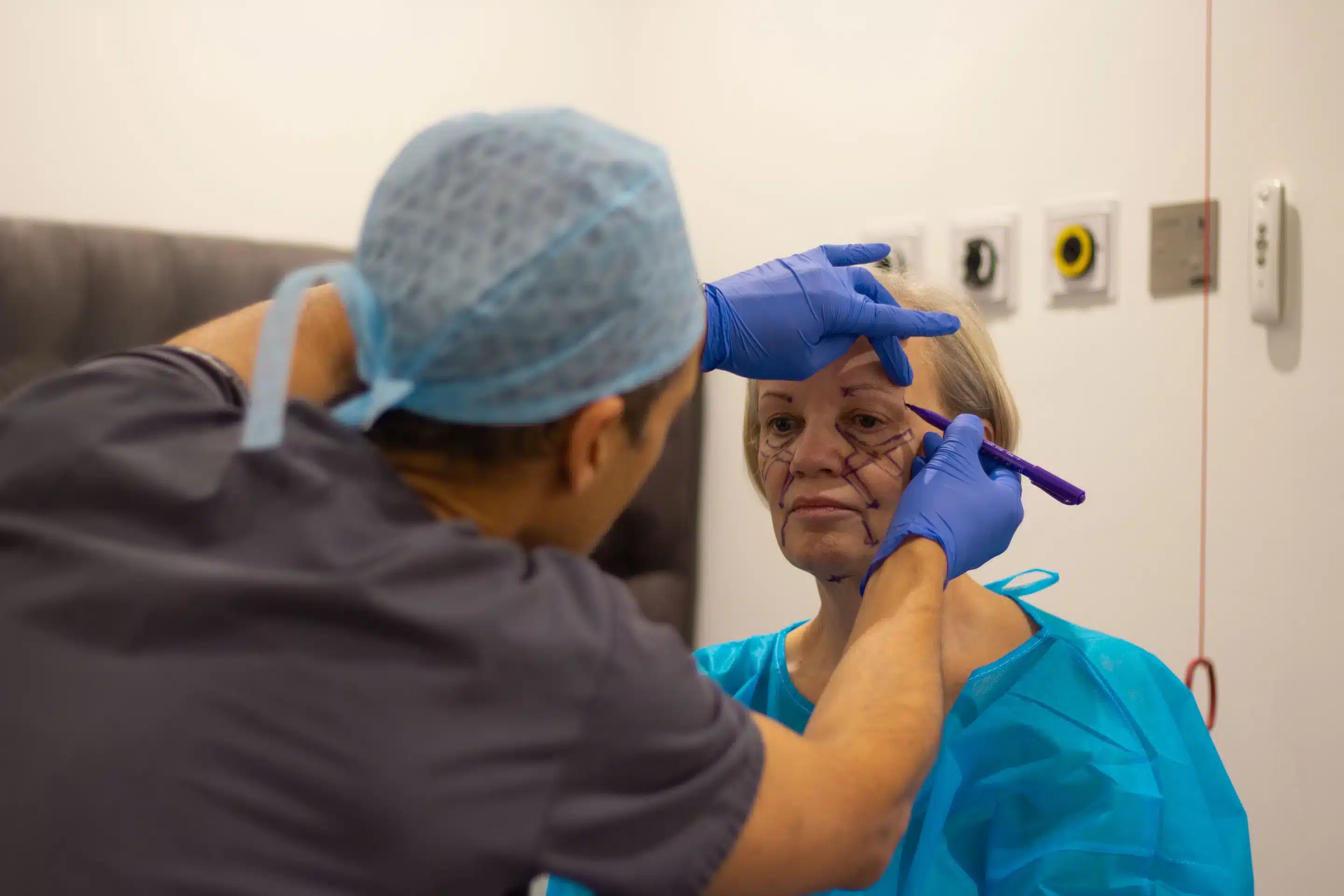
Dr De Silva uses advanced facial analysis to assess proportion, symmetry and balance before creating an individual surgical plan. He describes facial surgery as a combination of technical precision and artistic judgement rather than a standard set of measurements applied to every patient.
The Golden Ratio can be one useful component of this assessment. It provides a framework for evaluating the relationships between facial features, but it is not a template that every face should be made to follow.
Ethnicity, gender, facial structure and personal identity must all be respected. The objective is never to make every patient look the same. It is to recognise the proportions that suit that particular individual.
Why Subtle Changes Can Have a Significant Effect
The face is an interconnected structure. Even a relatively small change to one area can influence how the entire face is perceived.
For example, altering brow position may affect how open or tired the eyes appear. Refining the chin can change the apparent strength of the jawline and the balance of the profile. Restoring cheek support can affect both the midface and the transition into the lower eyelid.
This is why treating one concern in isolation can sometimes produce an unbalanced result. Effective facial rejuvenation requires an understanding of how the different areas interact.
The best results are often not immediately identifiable as surgery. Friends and family may notice that someone looks brighter, healthier or more rested without being able to identify precisely what has changed.
Cosmetic Treatment and Self-Acceptance Are Not Opposites
Choosing a cosmetic treatment does not necessarily mean that someone is rejecting the ageing process. Similarly, choosing not to undergo treatment does not mean that someone is more confident or secure.
The motivation behind the decision matters.
Some patients seek treatment because a particular feature has concerned them for many years. Others feel that changes associated with ageing no longer reflect how energetic they feel internally. These can be reasonable motivations, provided the decision is personal, realistic and carefully considered.
Problems can arise when treatment is pursued primarily to satisfy someone else, follow a temporary social-media trend or achieve an unrealistic ideal. Cosmetic surgery cannot create lasting internal validation. It can, however, address a specific physical concern when it is approached with appropriate expectations.
A responsible consultation should therefore explore not only what a patient wishes to change, but also why they wish to change it.
Natural Results Should Preserve Identity
Dr De Silva’s philosophy is centred on achieving natural-looking results that preserve each patient’s identity. Facial mapping and the Golden Ratio may help guide treatment planning, but individuality remains essential.
The goal is not to remove every line or create an artificial version of youth. It is to restore balance, soften the changes that trouble the patient and ensure that the result remains appropriate for their anatomy. Dr De Silva’s facial-only practice applies this approach across procedures including facelift surgery, blepharoplasty and rhinoplasty.
Zoë Kravitz’s comments offer a timely reminder that our relationship with ageing must extend beyond the mirror. Physical treatments can make meaningful improvements, but confidence also depends on accepting that change is a natural part of life.
Ultimately, the most successful approach combines realistic self-acceptance with informed personal choice. When cosmetic treatment is selected, it should enhance facial harmony not replace the person behind the face.
Book a Consultation with Dr De Silva
To discuss your concerns and explore the most appropriate treatment options, book a consultation with Dr De Silva.